The HUUM vs Harvia decision is not a simple contest between a modern design brand and a traditional manufacturer. Both companies sell serious electric sauna heaters, high-stone-capacity options, connected controls, and models intended for residential use. The better brand depends on the heater family, room volume, glass area, bench layout, installation market, desired steam character, control package, and the service support available after purchase.
HUUM is especially compelling for buyers drawn to exposed stone, sculptural stainless-steel forms, and the UKU control ecosystem. Harvia offers a broader heater catalog, ranging from straightforward wall-mounted units to large pillar heaters and newer design-focused models with substantial stone capacity. Comparing a HUUM DROP with a basic Harvia KIP or Vega therefore highlights product philosophy, while comparing DROP with Harvia Spirit produces a much closer match.
This guide compares design, controls, stone capacity, steam quality, heater families, installation, maintenance, support, and ideal sauna configurations. It also explains Rodeo Wellness's current heater-upgrade path: HUUM DROP 6 kW and 9 kW options paired with the Wi-Fi UKU controller. Those upgrades should be evaluated against the standard heater supplied with the exact sauna, not treated as a universal replacement for every cabin.
Quick Verdict
Choose HUUM when visual design, a large exposed stone basket, softer-feeling steam, and the UKU app-and-controller experience are central priorities. Choose Harvia when you want the broadest model range, multiple price and control levels, long-established heater categories, and the ability to match anything from a compact wall heater to a high-capacity pillar or commercial-style system.
For design-led residential saunas, HUUM DROP is often the more distinctive premium upgrade. For the widest range of rooms and budgets, Harvia is the stronger brand overall. Rodeo Wellness buyers who want a visual and steam-quality upgrade should specifically compare the HUUM DROP 6 kW or 9 kW with Wi-Fi UKU control against the standard Harvia configuration and confirm the room calculation, electrical change, clearances, and final installed price.
|
Decision Factor
|
HUUM
|
Harvia
|
| Design identity |
Sculptural, exposed-stone, minimalist |
Broad range from practical to premium design |
| Control ecosystem |
UKU Local, Wi-Fi, or other supported variants |
Built-in dials, Xenio, Fenix, and MyHarvia options |
| Stone strategy |
High visible stone capacity is central to many models |
Varies widely from compact baskets to large pillars |
| Steam character |
Often selected for mild, long-lasting steam |
Varies by model; pillar and Spirit models emphasize abundant stones |
| Model breadth |
Focused electric and wood-heater families |
Very broad residential and professional catalog |
| Best buyer |
Design-led owner who wants a coordinated premium system |
Buyer prioritizing choice, familiarity, and configuration range |
How We Evaluated HUUM and Harvia
This is a research-based commercial guide prepared for Rodeo Wellness readers. It does not claim physical side-by-side testing of every heater. The comparison uses current official product specifications, manuals, controller information, stone guidance, and the practical factors that determine whether a heater works in a particular room.
We weighted heater-room compatibility, stone capacity, steam control, design, clearances, electrical requirements, ventilation, controls, remote-start safeguards, installation documentation, maintenance, model breadth, and service access. Exact North American and international configurations can differ by voltage, certification, controller, and included accessories, so buyers must verify the product sold in their market.
Rodeo Wellness sells sauna packages and offers HUUM DROP upgrades, so readers should consider that commercial relationship. The recommendations remain conditional. HUUM is not favored merely because it is an upgrade, and Harvia is not favored merely because its name is familiar. The correct heater is the approved model that fits the completed sauna and the owner's priorities.
HUUM and Harvia at a Glance
HUUM is an Estonian sauna company known for heaters that place rounded stones at the center of the visual experience. DROP, HIVE, HIVE Mini, CLIFF, STEEL, and CORE address different room sizes and installation geometries. The product language emphasizes exposed stone, gentle steam, stainless-steel construction, and connected operation through UKU.
Harvia is a Finnish sauna manufacturer with a much wider catalog spanning electric heaters, wood-burning stoves, controls, sauna rooms, and accessories. Its electric lines include familiar wall heaters such as KIP and Vega, column heaters such as Cilindro, design heaters such as Spirit, large-stone products such as Legend, and systems for residential and professional rooms.
The practical consequence is that HUUM comparisons often begin with a desired aesthetic and stone experience, then identify the correct output. Harvia comparisons often begin with room type and budget, then select from multiple heater shapes, stone capacities, control styles, and price levels. Neither method is better, but buyers should recognize the difference.
Design and Visual Impact
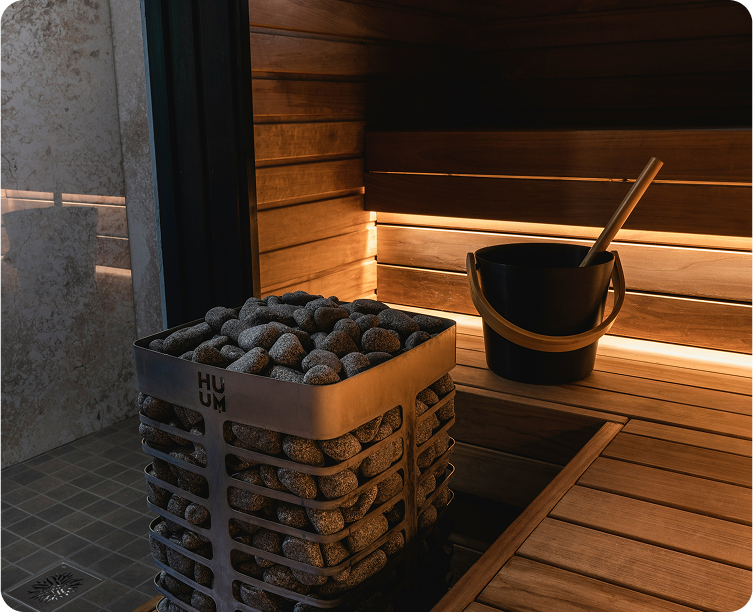
HUUM's strongest advantage is visual consistency. DROP resembles a suspended water droplet filled with stones; HIVE uses a cylindrical basket; CLIFF and STEEL emphasize narrow vertical geometry. These heaters are intended to remain visible rather than disappear behind a conventional metal shell. In glass-front cabins, the heater can become the interior focal point.
Harvia offers more visual variety. A Vega or KIP is a recognizable compact wall heater built around practical packaging. Cilindro turns a tall mass of stones into a column. Spirit uses curved steel and exposed round stones for a contemporary wall-mounted appearance. Legend uses a darker cage and heavy stone presence. Buyers can stay utilitarian or move into design-led territory without leaving the brand.
Aesthetic value should not override bench space, clearances, guards, and service access. A beautiful heater installed too close to a bench, squeezed into a narrow aisle, or hidden behind an improvised rail will not deliver the intended experience. Draw the exact unit and required protection into the floor plan before paying for design.
Which Brand Wins for Design
HUUM wins for a coherent, unmistakably modern identity. Harvia wins for choice because buyers can select understated, traditional, industrial, or premium forms. For a small modern cube or panoramic barrel where the heater remains highly visible, DROP can justify its upgrade status. For a traditional wood-heavy cabin, a simpler Harvia can feel visually appropriate and preserve budget for benches or site work.
Stone Capacity
Stone capacity affects heat storage, warm-up behavior, steam response, maintenance, and appearance. More stones can provide a softer, longer-lasting steam when the heater is properly warmed and water reaches hot stone surfaces. They can also increase warm-up time, total installed weight, and the labor required to inspect and restack the heater.
HUUM currently specifies approximately 55 kilograms, or 121 pounds, of stones for DROP across its listed outputs. That is unusually high for a compact wall-mounted heater and is one of its defining advantages. HUUM recommends appropriate 5-to-10-centimeter sauna stones and detailed hand placement that covers the elements while preserving airflow.
Harvia stone capacity varies dramatically. The 6 kW Vega BC60 lists 20 kilograms, or about 44 pounds. The 6 kW Spirit lists about 60 kilograms, or 132 pounds, in a current North American specification. The 9 kW Cilindro PC90 listing shows approximately 80 kilograms, or 176 pounds, while other regional variants and model suffixes can differ.
This means brand-level claims are misleading. DROP holds far more stone than a basic Vega or KIP, but a Spirit or Cilindro can equal or exceed it. Compare the exact heater, approved stones, element coverage, ventilation channels, and room match rather than assuming all Harvia heaters have small baskets.
|
Representative Heater
|
Power Reference
|
Published Stone Capacity
|
Design Type
|
| HUUM DROP 6 |
6 kW at 240V market configuration |
55 kg / about 121 lb |
Wall-mounted exposed-stone basket |
| HUUM DROP 9 |
9 kW at 240V market configuration |
55 kg / about 121 lb |
Wall-mounted; heat-guiding component listed |
| Harvia Vega BC60 |
6 kW |
20 kg / about 44 lb |
Compact wall heater with manual controls |
| Harvia Spirit SP60E |
6 kW |
60 kg / about 132 lb |
Design wall heater with separate controls |
| Harvia Cilindro PC90 |
9 kW |
80 kg / about 176 lb in cited model |
Floor-standing stone pillar |
Steam Quality
Steam quality cannot be reduced to brand. It depends on stone mass, stone temperature, surface area, water placement, room ventilation, bench height, heater output, and how long the system has warmed. The user also changes the experience by pouring a small amount on top, spreading it across the sides, or allowing recovery between rounds.
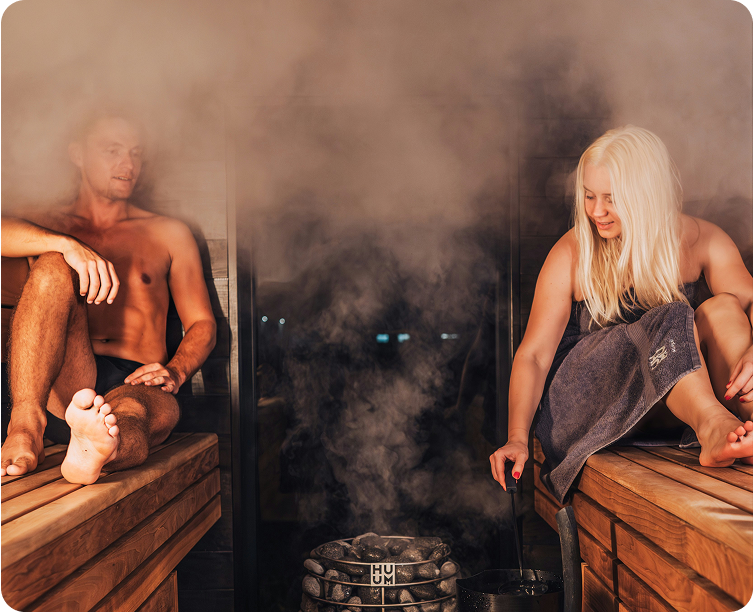
HUUM markets DROP around mild and long-lasting steam. Its open basket and large stone load allow water to meet different depths of hot stone, while rounded stones are recommended for gradual evaporation. When properly installed and heated, the result appeals to buyers who want a softer wave rather than an immediate sharp burst.
Harvia steam character depends on family. Vega and KIP use smaller conventional baskets and can feel more direct and responsive. Cilindro allows water on the side for softer steam or on top for a stronger response. Spirit uses a large stone amount and ventilation channels intended to combine quick heating with even distribution and gentle steam.
A larger stone mass is not automatically better for a short session. It must be heated thoroughly. Buyers who want fast, frequent weekday use may prefer a more responsive conventional heater. Buyers who allow a longer preheat and value long steam cycles may prefer DROP, Spirit, Cilindro, or another high-stone design.
Warm-Up Time
Warm-up depends on room volume, starting temperature, insulation, glass, ventilation, heater output, stone mass, and thermostat behavior. Brand claims such as fast or long-lasting need to be evaluated against the complete system. A small basket may heat the air quickly; a large stone load may take longer to become fully ready for repeated steam.
HUUM DROP's 55-kilogram capacity gives it thermal mass but also demands proper sizing and installation. Selecting 6 kW for a room at the edge of its adjusted range can produce a different experience from using 9 kW in an approved larger cabin. Glass fronts and outdoor winter starts must be included in the calculation.
Harvia offers more ways to trade warm-up against stone mass. A Vega or KIP is straightforward and comparatively light in stones. Spirit is designed with ventilation channels that Harvia says support quick heating despite substantial stone capacity. Cilindro and Legend emphasize stone volume and steam versatility. The model, not the logo, determines the balance.
HUUM UKU Controls
UKU is HUUM's control system for compatible electric heaters. The system separates the low-profile control panel from the power and sensor components and is available in different connectivity configurations. UKU Wi-Fi enables local panel operation and control through the HUUM mobile app when the network, account, setup, and safety requirements are satisfied.
The UKU ecosystem appeals to buyers who want a clean, minimal control panel with enclosure choices that can complement the sauna. It can regulate temperature and operating time and may control compatible lighting or ventilation depending on configuration. The installer must follow the manual for sensor, power unit, door sensor, wiring, and permitted environments.
Remote start is not unrestricted. The system must know that the sauna is in a safe state, and the room must be inspected so nothing is on or near the heater. Wi-Fi reliability, router placement, app service, firmware, and account access add dependencies that a basic mechanical control does not have. Local panel operation remains important.
Rodeo Wellness HUUM Upgrade
Rodeo Wellness currently uses HUUM DROP 6 kW and 9 kW options with the Wi-Fi UKU controller for heater upgrades. This is a coordinated premium package rather than a heater-only swap. Buyers should confirm which DROP output is approved for the selected cabin, whether the upgrade includes stones, safety railing, heat diverter or guiding components, door sensor, power unit, and all installation hardware.
The 6 kW and 9 kW choice should follow adjusted room volume, not a desire for faster heat. A 9 kW upgrade can change breaker, conductor, control, clearance, and component requirements. Current HUUM North American literature lists DROP 6 and DROP 9 differently at 240V and 208V, so the final quote and electrician must use the precise market model.
Harvia Controls
Harvia spans simple built-in dials and separate digital systems. Basic Vega and KIP variants may use manual controls, which reduce connected complexity and suit buyers who start the sauna locally. E, XE, and XW model distinctions can indicate separate controls or connected compatibility, but suffixes and market availability must be checked carefully.
Xenio provides a compact digital interface, and compatible Xenio Wi-Fi systems work with the MyHarvia app. Harvia describes functions such as heater operation, temperature, lighting, ventilation, timers, and door-sensor safety depending on the attached equipment. The current Fenix platform adds a touchscreen, presets, app compatibility, and learning features for supported systems.
Harvia's advantage is control choice. A buyer can stay with reliable local dials, use a separate digital panel, or select a premium connected system. The disadvantage is configuration complexity: not every Harvia heater works with every controller, and a familiar family name may contain manual, externally controlled, and Wi-Fi-ready versions.
UKU vs MyHarvia
UKU offers a visually cohesive system closely associated with HUUM's design philosophy and can control compatible heaters from more than one manufacturer when properly specified. MyHarvia integrates with Harvia's supported control units and equipment, while Fenix adds a newer interface and learning features. The better platform depends on exact compatibility, network requirements, safety hardware, app support, and installer familiarity.
Heater Model Range
HUUM's electric range is focused. DROP serves buyers needing a wall-mounted design heater with large stone capacity. HIVE and HIVE Mini provide cylindrical baskets for larger or central installations. CLIFF and STEEL use narrow vertical forms for tight footprints. CORE places more solid metal around a configurable body and suits buyers who want a different architectural expression.
Harvia's range is broader and more segmented. KIP and Vega cover familiar wall-mounted residential use. Spirit brings premium exposed stones and advanced safety. Cilindro provides several pillar formats, including corner and semi-open versions. Legend, Virta, The Wall, Forte, and professional systems address other capacities, installation styles, and operating patterns.
A broad catalog makes Harvia easier to match to unusual rooms, commercial requirements, replacement scenarios, and price points. HUUM's smaller range can make the design language and UKU experience more consistent. Buyers should compare the best model from each brand for the same room rather than treating an entry-level Harvia as the brand's ceiling.
HUUM DROP 6 kW
The DROP 6 is the most relevant HUUM upgrade for many compact and medium residential saunas. HUUM's current North American material lists 6 kW output at 240V, 55 kilograms of stones, wall mounting, and a room range that must be adjusted for glass, logs, and other non-insulated surfaces. Electrical details vary with supply voltage.
Its strengths are visual impact, high stone mass in a compact footprint, and connection to UKU controls. The open stone basket can complement panoramic glass or a modern wood interior. The installation demands careful stone placement, element coverage, airflow, wall mounting, clearances, sensor position, and an appropriate safety railing.
DROP 6 is not automatically right for every two-to-four-person label. A glass-heavy outdoor cabin may calculate beyond its approved range, while a smaller insulated room may fit well. Rodeo buyers should ask for the completed volume calculation and compare expected warm-up with the standard heater before choosing the upgrade.
HUUM DROP 9 kW
The DROP 9 extends the same visual form to larger approved rooms. HUUM currently lists the same 55-kilogram stone capacity and notes that the 9 kW set includes a heat-guiding device. North American documentation shows a higher electrical requirement at 240V than DROP 6, making early electrician review essential.
DROP 9 suits larger cabins or rooms whose glass and construction adjustments move them beyond 6 kW sizing. It can be a strong option for four-to-six-person outdoor models when the manufacturer approves the pairing. It should not be selected merely to reduce waiting, because heater output, room minimums, safety distances, and control components are designed as a system.
Buyers should confirm the exact heat diverter or guiding device, element retainer, railing, stones, power unit, sensor, door sensor, controller enclosure, cable, and installation labor included in the upgrade. A complete installed quote is more useful than the price difference between heater bodies.
Harvia Vega and KIP
Vega and KIP represent Harvia's practical wall-heater approach. They are compact, familiar, and available in multiple outputs and control configurations. Harvia's 6 kW Vega BC60 listing shows a 20-kilogram stone capacity and manual controls. A current KIP 60E listing also shows about 20 kilograms, though market versions differ.
These heaters appeal to buyers who want dependable traditional heat without making the heater the design centerpiece. A smaller stone basket can respond quickly and requires less loading work. It may produce a more immediate steam character than a high-mass basket and can fit cabins where floor area is limited.
Their main disadvantage against DROP is the smaller visible stone mass and more utilitarian appearance. For many households, those differences do not reduce practical value. A standard Harvia package can be the sensible choice when fast routine use, budget discipline, local familiarity, and straightforward replacement matter most.
Harvia Spirit
Spirit is Harvia's closest wall-mounted conceptual competitor to DROP. Current 6 kW North American specifications list a substantial 60-kilogram stone amount, curved exposed-stone design, separate control requirement, and ventilation channels intended to support quick and even heating. Some versions include integrated remote-start safety features.
Spirit weakens the idea that HUUM alone owns the design-plus-stone category. It can provide more published stone capacity than DROP while remaining wall-mounted. Its shape is less like a suspended droplet and more like a curved steel cradle, so aesthetic preference remains meaningful.
A buyer comparing DROP 6 with Spirit 6 should focus on exact room range, stone package, clearances, controller and safety system, electrician familiarity, installed price, app preference, and support channel. The comparison is much closer than DROP versus Vega.
Harvia Cilindro
Cilindro is a floor-standing pillar family designed around a tall exposed stone mass. A current 9 kW PC90 specification lists about 80 kilograms of stones, while other regional and corner variants list different amounts. Water can be applied to the side for softer steam or the top for a sharper response.
Cilindro is well suited to medium and larger cabins with enough floor area and suitable bench integration. It can become a visual centerpiece like HUUM HIVE rather than DROP. The height and circular exposure create many steam surfaces, but the heater, guard, and clearances need careful placement in the aisle or bench.
Against DROP 9, Cilindro may offer more stone mass and a different steam-control technique, while DROP preserves wall mounting and a shorter sculptural profile. The best choice depends on whether the room has wall or floor space and how users will reach the stones safely.
Installation Requirements
Both brands require professional electrical work and exact adherence to their manuals. Heater output, supply voltage, breaker, conductor, control cable, power unit, sensor, safety device, mounting surface, stone loading, ventilation, and clearances must match. Product pages are useful for planning but do not replace the installation documents packaged with the exact market model.
HUUM DROP places unusual importance on stone loading. Stones are laid individually, with larger pieces at the bottom and sides and smaller pieces filling gaps while airflow remains available. Elements should be covered from direct water exposure. The DROP 7 and 9 instructions include model-specific guidance around retainers, and DROP 9 uses an additional heat-guiding component in current listings.
Harvia installation varies more by family. A Vega may use built-in controls and a conventional wall bracket. Spirit requires a separate control and may integrate a safety device. Cilindro is floor-standing and can have more complex bench or corner placement. Installer experience with the exact family is more important than general familiarity with the brand.
Electrical Planning
Do not compare 6 kW or 9 kW labels without voltage and market context. HUUM's published DROP tables show different effective outputs, fuse requirements, and room ranges at 208V and 240V. Harvia also sells market-specific electrical versions. The electrician should use the model number, rating plate, manual, and controller documentation, not a generic online summary.
Safety Clearances and Railings
Every heater requires clearance from combustible walls, benches, ceilings, and guards. These distances vary by output and configuration. A higher-output unit may need more space even when the outer shell looks identical. Bench embedding can introduce additional flanges, protrusion requirements, shields, and service-access rules.
HUUM strongly recommends a safety railing around DROP. The heater's open stones and sculptural form invite close placement in design renderings, but bathers still need protection from contact and a clear route past it. Use a manufacturer accessory or a professionally designed rail that respects every required distance.
Harvia provides model-specific railing and installation options across its lines. Spirit includes integrated safety functions in some current variants, while Cilindro may be embedded or surrounded with approved accessories. Remote-start safety and physical burn protection solve different problems; a door sensor does not replace a guard.
Ventilation and Sensor Placement
Ventilation affects both brands. The heater needs fresh air and a path that supports circulation without cooling the sensor incorrectly. Supply and exhaust positions depend on mechanical or gravity ventilation, heater location, and room design. The exact heater and controller manuals should be coordinated before vents are cut.
A large open stone basket changes airflow through the heater. Packing stones too tightly can restrict it; packing them too loosely can expose elements and create unsafe direct water contact. HUUM's placement guidance therefore balances element coverage with internal circulation. Harvia's high-stone heaters have their own stacking and ventilation instructions.
Sensor placement is essential for temperature control and overheat protection. Avoid improvising around glass, doors, corners, or vents. A sensor cooled by supply air may report a lower temperature than the room, while one placed in an unusually hot pocket may cycle the heater early. Follow the exact diagram.
Maintenance and Stone Care
High-stone heaters require a real stone-maintenance routine. Stones crack, settle, produce dust, and change airflow through heat cycles. Both brands instruct users to inspect and restack or replace stones as needed. The more stones a heater holds, the more time and weight the task involves.
HUUM warns against pouring stones into DROP and recommends laying them individually. Unsuitable decorative stones can break and block airflow, while exposed elements may be damaged by water. Its round olivine-diabase recommendations support both appearance and gradual steam, but the exact approved stone range should be followed.
Harvia requirements differ by family. Basic wall heaters are quicker to unload because they hold less stone. Spirit and Cilindro require more handling but deliver the benefits of greater mass. Inspect elements, retainers, guards, fasteners, sensors, and control behavior during service, and use a qualified technician for electrical faults.
Reliability and Serviceability
Reliability depends on installation, ventilation, stone placement, water quality, usage, voltage, ambient conditions, and maintenance as much as manufacturer. A respected brand cannot compensate for an undersized heater, incorrect sensor, buried elements, restricted airflow, or a circuit that does not match the rating plate.
Harvia's broad market presence and long catalog may make dealers, parts, and installer familiarity easier to find in some regions. Its many product variants can also create ordering mistakes if model suffixes are ignored. Buyers should verify that the local distributor supports the exact heater and control version.
HUUM support is often mediated through the sauna seller or authorized dealer, which makes the quality of the retail relationship important. Confirm who handles diagnostics, elements, controller modules, warranty claims, and freight for heavy or oversized components. Rodeo buyers should ask whether support for the DROP-and-UKU upgrade is coordinated directly through Rodeo Wellness.
How to Evaluate Support Before Buying
Call or email with a real installation question and note the quality of the response. Ask about current lead times for elements, sensors, power units, panels, and stone accessories. Read the written warranty and identify labor, shipping, and installation exclusions. A strong support path can be worth more than a small specification advantage.
Price and Complete Installed Cost
HUUM DROP is usually positioned as a premium heater-and-control upgrade. The complete cost can include the heater, 55 kilograms of stones, UKU power system, Wi-Fi panel, sensor, door sensor, safety railing, heat-guiding component for DROP 9, cable, electrician labor, and any circuit change.
Harvia pricing spans a wider range. A manual Vega or KIP can be relatively economical, while Spirit, Cilindro, Legend, Fenix, and Xenio configurations can move into premium territory. Comparing a DROP package with a heater-only Harvia price is misleading; controls, stones, safety equipment, and electrical work must be normalized.
Request two written configurations for the selected sauna: the standard package and the full upgrade. Confirm heater model number, output at site voltage, control, stones, accessories, freight, installation, warranty, and expected room range. The upgrade is worthwhile when its steam, design, or control benefits matter enough to justify the entire difference.
Energy Use
A 6 kW heater and another 6 kW heater have similar maximum electrical demand in principle, but actual energy use depends on warm-up duration, thermostat cycling, room loss, stone mass, starting temperature, door openings, and session length. High stone capacity can extend warm-up but also store heat and support repeated steam.
A 9 kW heater draws more power at full output than a 6 kW heater, but it may be the correct and efficient choice for a larger adjusted room. Undersizing can produce long operation and disappointing recovery. Oversizing outside the approved range can create control and safety problems. Proper matching matters more than chasing a lower nameplate.
Estimate local operating cost by multiplying kilowatts by full-power-equivalent hours and the electricity rate, then adjust from real use. Do not assume one brand is inherently more efficient without equivalent room tests and control settings. Room construction is often the stronger variable.
Ideal Sauna Configurations for HUUM
HUUM DROP fits design-led small and medium rooms where wall mounting saves floor area and the heater remains visible. It works particularly well with panoramic glass, modern vertical cladding, compact cubes, and barrels whose entry sightline highlights the stone basket. Bench and guard placement must preserve safe access.
HIVE and HIVE Mini suit larger rooms or layouts that can support a central or floor-standing cylinder. CLIFF and STEEL suit narrow footprints and vertical architecture. CORE suits buyers wanting configurable panels and a more contained appearance. Each has different stone and clearance implications.
HUUM is most persuasive when the owner values steam texture and design enough to allow full warm-up and perform stone maintenance. Buyers wanting the simplest inexpensive heater may not capture the value of the premium system.
Ideal Sauna Configurations for Harvia
Harvia KIP and Vega suit compact cabins, traditional barrels, and budget-conscious residential installations where a practical wall heater is appropriate. They are strong standard-package choices when the room calculation is straightforward and local installers know the family.
Spirit suits design-focused small and medium rooms that want substantial stone capacity without giving up wall mounting. Cilindro suits medium and larger cabins where a floor pillar can be reached from the bench and where users want to vary steam by water placement. Legend and Virta address other high-capacity or premium rooms.
Harvia is the safer starting brand when the property needs an unusual output, control style, commercial duty, corner unit, replacement match, or broad dealer network. The correct model may cost as much as HUUM, but the catalog offers more ways to solve the room.
Rodeo Wellness Upgrade Decision
Rodeo Wellness buyers should begin with the standard heater included in the selected sauna, then compare the HUUM DROP upgrade as a complete system. The relevant upgrade choices are DROP 6 kW and DROP 9 kW with the Wi-Fi UKU controller. This should be stated clearly in the product quote and installation plan.
Choose DROP 6 when the adjusted room volume, glass, log construction, climate, and manufacturer approval place the cabin in its range. Choose DROP 9 when the approved calculation requires the higher output. Do not infer the correct upgrade from capacity alone, because two four-person saunas can have different interior volumes and glass areas.
The upgrade is strongest for owners who will appreciate the sculptural heater every session, prefer large-stone steam, and will use Wi-Fi scheduling responsibly. Keep the standard Harvia when lower cost, simpler controls, quick routine operation, or familiar local service matters more than the design transformation.
|
Rodeo Buyer Priority
|
Recommended Direction
|
Reason
|
| Premium visible heater |
HUUM DROP upgrade |
Distinctive wall-mounted stone basket |
| Wi-Fi through UKU |
HUUM DROP upgrade |
Coordinated UKU Wi-Fi controller and app |
| Lowest complete price |
Standard Harvia package |
Avoids premium heater and controller change |
| Large-stone steam |
Compare DROP with Spirit or Cilindro |
Exact Harvia model may match or exceed stone mass |
| Simple local controls |
Harvia manual-control option |
Less app and network dependency |
| Best room match |
Use approved calculation |
Output, glass, insulation, voltage, and clearances decide |
How to Choose Between HUUM and Harvia
First calculate the finished room. Include interior volume, glass area, log or masonry surfaces, insulation, ceiling, and climate according to the heater manufacturer's method. Eliminate any model that does not fit the approved range at the site's actual voltage.
Second, compare physical integration. Draw the heater, rail, clearances, sensor, vents, door, lower bench, upper bench, and maintenance path. Confirm whether wall or floor mounting preserves more usable seating. Check stone weight against the mounting surface and foundation.
Third, compare the entire control and service system. Verify panel location, power unit, safety device, Wi-Fi conditions, local operation, app support, electrician experience, parts, warranty, and seller responsibility. Only then compare design and price.
-
Room Match: Use finished adjusted volume and the exact market voltage.
-
Stone Experience: Decide whether quick response or high thermal mass fits the routine.
-
Control Preference: Compare built-in dials, UKU, Xenio, Fenix, and app dependencies.
-
Physical Fit: Protect bench space, clearances, railing, ventilation, and service access.
-
Support: Verify dealer, parts, warranty, electrician familiarity, and diagnostic process.
-
Installed Value: Normalize heaters, controls, stones, accessories, wiring, and labor.
Common Buying Mistakes
Comparing Brands Instead of Models
DROP versus Vega is not the same contest as DROP versus Spirit. Compare equivalent output, stone capacity, control package, certification, and installation style.
Choosing Output From Person Capacity
Heater size follows adjusted room volume, glass, insulation, logs, and voltage. A four-person label cannot select 6 kW or 9 kW safely.
Ignoring Voltage-Specific Output
The same model name can have different effective ratings and circuit requirements at 208V and 240V. Use the exact rating plate and manual.
Comparing Heater-Only Prices
Include controller, power unit, sensor, safety device, stones, rail, heat diverter, electrician labor, and circuit changes.
Packing Stones Incorrectly
Poor placement can restrict airflow or expose elements. Follow the exact size, material, washing, and stacking instructions for the model.
Treating Wi-Fi as a Safety Substitute
Remote control requires approved safety hardware and a physical check that the room is ready. App access does not make unattended hazards acceptable.
Assuming More Stones Always Means Faster
More mass can improve stored heat and steam but may need longer warm-up. Match the heater and routine instead of maximizing one specification.
Frequently Asked Questions
Is HUUM Better Than Harvia
HUUM is often better for sculptural design, exposed stone, and the UKU ecosystem. Harvia is better for overall model breadth, control choice, and matching a wide range of rooms. The exact heaters decide.
Is HUUM DROP Better Than Harvia KIP
DROP offers much greater published stone capacity and stronger visual impact. KIP is simpler, more conventional, and often more economical. Choose from steam preference, controls, installation, and complete price.
Is HUUM DROP Better Than Harvia Spirit
This is a close comparison. Both are wall-mounted design heaters with substantial stone capacity and connected-control options. DROP emphasizes its droplet form and UKU; Spirit offers Harvia's ventilation-channel design and safety ecosystem.
Which Brand Makes Softer Steam
High-stone models from both brands can produce mild steam. DROP, Spirit, Cilindro, and other basket heaters differ in stone mass and water placement. Room and operation matter as much as brand.
How Many Stones Does HUUM DROP Hold
HUUM currently specifies approximately 55 kilograms, or 121 pounds, of approved sauna stones for DROP models. Follow the exact size and stacking instructions.
Which Harvia Heater Has Similar Stone Capacity
Harvia Spirit 6 kW currently lists about 60 kilograms in one North American specification. Cilindro models can hold roughly 50 to 90 kilograms depending on exact variant. Verify the market model.
What Is the Difference Between DROP 6 and DROP 9
They serve different approved room ranges and electrical loads. DROP 9 includes additional heat-guiding equipment in current listings. Both list 55 kilograms of stones. Use the exact voltage-specific documents.
Does Rodeo Wellness Offer HUUM Upgrades
Yes. Rodeo Wellness uses HUUM DROP 6 kW and 9 kW heaters with the Wi-Fi UKU controller as upgrade options. Availability and the correct output depend on the selected sauna and current quote.
Can UKU Control a Harvia Heater
HUUM states that UKU is compatible with electric sauna heaters from various manufacturers, but the precise heater, power unit, certification, wiring, and warranty must be approved by the seller and installer.
Is MyHarvia Better Than the HUUM App
Both provide connected control in supported systems. MyHarvia integrates with Harvia controls and equipment; the HUUM app integrates with UKU. Compare local control, safety devices, network requirements, features, support, and installer familiarity.
Do I Need Wi-Fi
No. Local controls can operate without app dependence when the chosen system supports them. Wi-Fi is valuable for scheduling and monitoring but adds network, account, firmware, and safety setup.
Which Brand Heats Faster
No brand always wins. Output, room loss, ventilation, stone mass, and starting temperature control warm-up. Compare equivalent models in the completed room.
Which Heater Is Better for a Barrel Sauna
A compact wall heater often preserves the aisle. DROP, Spirit, KIP, and Vega can suit approved barrels, while larger pillar heaters need adequate space. Use the sauna manufacturer's pairing.
Which Is Better for a Panoramic Sauna
Large glass increases calculated heat demand. Either brand can work when sized correctly. HUUM may complement the modern aesthetic; Harvia offers more output and model choices.
Are HUUM Heaters Harder to Maintain
DROP's large stone load takes more time to inspect and restack than a small conventional basket. Harvia high-stone heaters require similar care. Basic Harvia wall heaters are quicker to service.
Can I Upgrade From 6 kW to 9 kW Later
Possibly, but the circuit, controller, clearances, room range, sensor, accessories, and warranty must support it. Plan the correct output before installation.
Editorial Review and Primary Sources
This article was reviewed against current manufacturer information on September 9, 2026. Models, certifications, voltage tables, stone requirements, controls, app features, prices, and support policies can change. Verify the exact market configuration before publication or purchase.
HUUM DROP official specifications
HUUM sauna stone guidance
HUUM UKU Wi-Fi controller
Harvia Spirit 6 kW official specifications
Harvia Vega BC60 official specifications
Harvia Cilindro PC90 official specifications
Harvia sauna control systems
Internal Linking Note
Link this guide to electric versus wood-burning heaters, heater sizing, ventilation, outdoor electrical planning, panoramic glass, cube versus barrel design, and Rodeo capacity guides. Keep this page focused on brand and model comparison so it supports rather than competes with general heater-selection content.
Final Thoughts
The HUUM vs Harvia comparison is closest when equivalent heater families are placed side by side. HUUM DROP clearly outclasses a basic Harvia wall heater in exposed stone and visual drama, but Harvia Spirit and Cilindro show that Harvia also offers high-stone premium experiences. Harvia's broader catalog remains its strongest brand-level advantage.
For Rodeo Wellness customers, the real decision is whether the DROP 6 kW or 9 kW upgrade with Wi-Fi UKU meaningfully improves the selected sauna. Confirm adjusted room volume, site voltage, electrical cost, clearances, railing, stones, accessories, warm-up expectations, and support before approving the package.
Buy HUUM for a specific design and control experience. Buy Harvia for the best-matched model from a wider ecosystem. Either can deliver excellent traditional heat and steam when the room, ventilation, stones, sensor, wiring, and benches are designed together.
Our Recommendation
For buyers seeking the strongest premium upgrade in a modern residential sauna, we recommend the HUUM DROP with UKU Wi-Fi control when the room calculation and installation approve it. The combination delivers a distinctive visual centerpiece, substantial 55-kilogram stone capacity, connected operation, and the mild, sustained steam profile many design-focused owners want.
For Rodeo Wellness configurations, choose DROP 6 kW for approved smaller and medium rooms and DROP 9 kW where the adjusted volume, glazing, construction, and manufacturer pairing require the higher output. Treat the heater, UKU controller, safety components, stones, railing, and electrical work as one package rather than separate upgrades.
Harvia remains our recommendation for buyers prioritizing the broadest selection, simpler manual controls, conventional value, or easier matching to unusual sauna sizes. Its premium Spirit and Cilindro models deserve direct consideration when stone mass matters. Overall, HUUM wins the design-led upgrade category, while Harvia wins for breadth and practical flexibility.



 OUR BEST SELLERS