How Much Electricity Does an Outdoor Sauna Use? (2026 Guide)
An outdoor sauna can feel like a substantial appliance because it creates temperatures approaching 200 degrees Fahrenheit, often in the middle of winter. That naturally leads homeowners to wonder whether regular sauna sessions will produce an equally substantial electricity bill. In most homes, the answer is reassuring: a properly sized electric sauna heater usually costs a few dollars or less per session, although the exact outdoor sauna electricity cost depends on heater size, local rates, warm-up time, climate, insulation, glass area, and how often the sauna is used.
The heater rating provides the starting point. A 6-kilowatt heater can draw up to 6 kilowatt-hours if it operates continuously at full output for one hour. At the May 2026 U.S. average residential electricity price of 18.44 cents per kilowatt-hour, that theoretical hour costs about $1.11. A 9-kilowatt heater running at full power for one hour costs about $1.66 at the same rate. Real sessions are more complicated because the heater may run continuously during warm-up and then cycle on and off after the thermostat reaches its set temperature.
That difference between rated power and actual energy use is where many online estimates become confusing. A heater labeled 9kW does not necessarily consume 9 kWh during every hour the sauna is available. Kilowatts describe the maximum rate of power draw. Kilowatt-hours describe the energy billed over time. Once the room is hot, the thermostat normally reduces full-power operation by cycling the heating elements, although cold weather, door openings, poor insulation, and large glass surfaces can keep the heater working harder.
This guide shows homeowners how to estimate operating cost without pretending that every sauna behaves the same way. It explains the calculation formula, compares common heater sizes, models short and long sessions, examines local utility rates, and shows how climate, construction, and usage frequency affect monthly and annual expenses. The goal is a practical budget you can update with your own heater and utility bill.
Outdoor Sauna Electricity Cost At A Glance
For a quick estimate, multiply the heater rating in kilowatts by the total hours of operation and your electricity price per kilowatt-hour. This produces a conservative full-load figure when you assume the heater remains on continuously. Actual metered use may be lower after warm-up because of thermostat cycling.
|
Heater size
|
Full-power energy in 1 hour
|
Cost at 18.44 cents/kWh
|
Typical application
|
| 4.5kW |
4.5 kWh |
$0.83 |
Compact sauna |
| 6kW |
6 kWh |
$1.11 |
Small to medium sauna |
| 8kW |
8 kWh |
$1.48 |
Medium sauna |
| 9kW |
9 kWh |
$1.66 |
Medium to larger sauna |
| 10.5kW |
10.5 kWh |
$1.94 |
Larger residential sauna |
These are maximum one-hour energy figures based on the nameplate rating, not promises of actual consumption. A 90-minute session includes both warm-up and bathing time, and the heater may cycle once the target temperature is reached. Your most reliable estimate comes from combining the heater rating with a realistic operating schedule and then checking the result against a dedicated energy monitor or utility interval data when available.
The Simple Formula For Sauna Electricity Cost
The basic calculation uses three numbers: heater power, operating time, and electricity price. The formula is straightforward:
Estimated cost = heater kilowatts x operating hours x electricity rate in dollars per kWh
Suppose a 6kW heater operates for 1.5 hours and electricity costs $0.1844 per kWh. The conservative full-power calculation is 6 x 1.5 x $0.1844, which equals about $1.66. For a 9kW heater under the same assumptions, 9 x 1.5 x $0.1844 equals about $2.49.
The calculation is conservative because it treats every minute as full output. That can be useful for budgeting, especially in winter, but it may overstate normal use after the sauna reaches temperature. To create a refined estimate, separate warm-up from the bathing period and apply an estimated duty cycle to the time after warm-up.
A More Realistic Two-Stage Calculation
Imagine a 6kW outdoor sauna that takes 45 minutes to warm up. During that period, assume the heater runs at full output. The warm-up consumes 6kW x 0.75 hour, or 4.5 kWh. The homeowner then bathes for 45 minutes. If the heater averages a 50% duty cycle during that period, the bathing portion consumes 6kW x 0.75 hour x 0.50, or 2.25 kWh. Total estimated use is 6.75 kWh.
At 18.44 cents per kWh, that session costs about $1.24. The conservative full-power method would estimate 9 kWh and $1.66, so the two-stage model lowers the estimate by about 42 cents. The duty cycle is only an assumption; a cold, glass-heavy sauna may cycle more, while a compact, well-insulated room in mild weather may cycle less.
-
Warm-up energy: heater kW x warm-up hours, usually modeled at full output.
-
Bathing energy: heater kW x bathing hours x estimated duty cycle.
-
Accessory energy: add lighting, controls, fans, or pumps when they are material to the project.
-
Session cost: total estimated kWh x the delivered electricity rate on your bill.
For a homeowner who wants accuracy rather than a planning estimate, measurement is better than guessing. A qualified electrician can discuss safe monitoring options for a hardwired heater. Some utility portals also show hourly or 15-minute usage, allowing the homeowner to compare a sauna day with a similar non-sauna day.
How Heater Size Changes Electricity Use
Heater size is the most visible variable because it sets the maximum rate of electrical consumption. Common residential electric sauna heaters range from approximately 4.5kW to 10.5kW or more. Manufacturers match these ratings to room-volume ranges; for example, Harvia lists a 6kW Top Steel model for sauna rooms of roughly 5 to 8 cubic meters and a 9kW option for approximately 8 to 14 cubic meters.
A larger heater draws more power while energized, but that does not mean the smallest heater always has the lowest real operating cost. An undersized heater may run continuously, struggle to reach the set temperature, and deliver disappointing heat. A properly sized larger heater can warm the room more decisively and then cycle. The right comparison is therefore total kWh per successful session, not wattage alone.
4.5kW Heaters
A 4.5kW heater is generally associated with compact sauna rooms. At full power, it uses 4.5 kWh per hour. At 18.44 cents per kWh, the theoretical hourly cost is about 83 cents. If the complete operating window is 90 minutes, the conservative maximum is 6.75 kWh, or about $1.24.
Compact rooms can be efficient because there is less air and interior material to heat, but their performance still depends on insulation and glass. A small outdoor sauna with a panoramic window can require more heater capacity than its floor area suggests. Always use the manufacturer sizing method rather than choosing from cost alone.
6kW Heaters
Six-kilowatt heaters are common in small and medium residential saunas. At full output, a 6kW heater consumes 6 kWh per hour. The conservative cost is approximately $1.11 per hour at the May 2026 national residential benchmark, $0.72 at a 12-cent rate, and $1.80 at a 30-cent rate.
For a 90-minute operating window, the full-power ceiling is 9 kWh. That equals $1.08 at 12 cents per kWh, $1.66 at 18.44 cents, or $2.70 at 30 cents. Actual use may be lower when the room reaches temperature and the thermostat cycles.
8kW And 9kW Heaters
Eight- and nine-kilowatt heaters serve medium and larger residential sauna rooms, especially when the design includes glass or cold-climate exposure. At full power, an 8kW heater costs about $1.48 per hour at 18.44 cents per kWh. A 9kW heater costs about $1.66 per hour.
The difference between a 6kW and 9kW heater at full power is 3 kWh per hour, or about 55 cents at the national benchmark. Over a 90-minute session, the maximum difference is about 83 cents. If the 9kW heater shortens warm-up or cycles sooner in a correctly sized larger room, the real difference may not follow the nameplate calculation exactly.
10.5kW And Larger Heaters
Large residential or commercial-style outdoor saunas may require 10.5kW, 12kW, or more. A 10.5kW heater consumes up to 10.5 kWh per full-power hour, costing approximately $1.94 at 18.44 cents per kWh. A two-hour maximum-load window would reach 21 kWh and about $3.87.
Larger systems may use external contactors, more stone mass, and longer warm-up periods. Their operating expense should be considered alongside capacity: if six people share a session, the energy cost per person can be modest even though the cabin uses more electricity than a two-person sauna.
Full-Power Cost By Heater Size And Session Length
The following table uses the May 2026 U.S. residential average of $0.1844 per kWh. It assumes continuous full-power operation, so it is best understood as a conservative ceiling for the stated operating window.
|
Heater
|
60 minutes
|
90 minutes
|
120 minutes
|
| 4.5kW |
$0.83 |
$1.24 |
$1.66 |
| 6kW |
$1.11 |
$1.66 |
$2.21 |
| 8kW |
$1.48 |
$2.21 |
$2.95 |
| 9kW |
$1.66 |
$2.49 |
$3.32 |
| 10.5kW |
$1.94 |
$2.90 |
$3.87 |
If your heater reaches temperature during the first part of the operating window, actual consumption can fall below these totals. However, using the full-power number is a responsible way to avoid underbudgeting when you do not yet have real meter data.
Local Electricity Rates Can Matter As Much As Heater Size
Electricity prices vary substantially by location, utility, season, and rate plan. The U.S. Energy Information Administration reported an average residential price of 18.44 cents per kWh for May 2026. The 2025 annual residential average was 17.30 cents. State and regional averages can be much lower or higher, and an individual household rate can differ from the published average.
The number that matters for your sauna is the incremental delivered cost of another kilowatt-hour. Look at the energy charge on your utility bill, but also identify fuel adjustments, delivery charges, taxes, and time-of-use pricing that change with consumption. Fixed monthly customer charges usually do not increase because of one sauna session, so including them in a per-kWh estimate can distort the marginal cost.
Cost At Low, Average, And High Utility Rates
|
Heater and time
|
At $0.12/kWh
|
At $0.1844/kWh
|
At $0.30/kWh
|
| 6kW for 1 hour |
$0.72 |
$1.11 |
$1.80 |
| 6kW for 1.5 hours |
$1.08 |
$1.66 |
$2.70 |
| 9kW for 1 hour |
$1.08 |
$1.66 |
$2.70 |
| 9kW for 1.5 hours |
$1.62 |
$2.49 |
$4.05 |
| 9kW for 2 hours |
$2.16 |
$3.32 |
$5.40 |
The table shows why a homeowner in a high-cost electricity market can spend more with a 6kW heater than another homeowner spends with a 9kW heater. Local rates should never be replaced by a national average when you have an actual bill available.
Time-Of-Use Rates
Some utilities charge different rates depending on the hour. Electricity may be most expensive on weekday afternoons and less expensive overnight or during off-peak periods. A sauna is often flexible enough to shift: an evening session after the peak window may cost less than an early evening session even when the heater uses the same number of kilowatt-hours.
Check whether your plan has peak, shoulder, and off-peak periods, and whether weekends or holidays follow different schedules. Also look for demand charges. Residential demand rates are not universal, but when they apply, operating a high-powered sauna heater at the same time as an electric vehicle charger, range, clothes dryer, and heat pump may affect more than the ordinary energy charge.
Tiered Rates And Seasonal Adjustments
Tiered plans increase the per-kWh price after household consumption passes one or more thresholds. A sauna used frequently may push the highest block of usage into a more expensive tier, particularly in an all-electric home. Seasonal rates can also make summer or winter kWh more expensive depending on the utility system.
For a conservative monthly budget, use the rate that applies to the next unit of consumption rather than dividing the entire bill by total kWh without interpretation. If the bill is difficult to read, the utility can explain which charges vary with usage.
How Session Length Affects Operating Cost
Session length includes more than time on the bench. The meter begins recording significant heater use when warm-up starts. If a sauna requires 45 minutes to heat and the household bathes for 45 minutes, the operating window is 90 minutes even though the wellness session itself feels shorter.
Preheating too early is a common source of avoidable energy use. A sauna scheduled to be ready at 7:00 p.m. but left empty until 7:45 p.m. has spent another 45 minutes replacing heat losses. Smart controls can improve timing, but convenience features save energy only when they are used thoughtfully and within all manufacturer safety instructions.
Short Sessions
A short session may consist of 30 to 45 minutes of warm-up followed by 20 to 30 minutes of bathing. The heater often spends a large share of this window at full output, so the average power draw can be relatively close to the nameplate rating. Shortening the bathing period does not eliminate the fixed warm-up energy.
Long Sessions
Longer sessions spread warm-up energy over more bathing time, but total kWh still increases because the heater must replace ongoing losses. Once the cabin is hot, insulation, outdoor temperature, ventilation, door openings, and setpoint determine how often the elements cycle. A two-hour gathering is not necessarily twice the cost of a one-hour operating window, but it will usually cost more.
Back-To-Back Users
Families often improve energy value by bathing in sequence. Heating the sauna once for several users usually consumes less energy than allowing the room to cool and reheating it for separate sessions. The total operating period may be longer, yet the warm-up portion occurs only once. From a cost-per-person perspective, shared sessions can be highly efficient.
Climate And Outdoor Temperature
Outdoor temperature changes how much energy the sauna must absorb during warm-up and how quickly it loses heat afterward. A sauna starting at 15 degrees Fahrenheit has farther to climb than one starting at 70 degrees. Wind can increase heat loss through the exterior envelope, and snow or moisture can reveal weaknesses in doors, seals, and roof details.
In a properly built sauna, heater sizing accounts for expected conditions, but winter sessions may still require longer warm-up and more cycling. The same homeowner can therefore see different electricity use in January and September without changing session habits.
Why Winter Costs More
-
Lower starting temperature: the room, benches, stones, and interior surfaces require more energy to reach operating temperature.
-
Greater heat loss: the temperature difference between the cabin and outdoor air is much larger.
-
Wind exposure: air movement can increase losses around imperfect seals and exterior assemblies.
-
Snow and moisture: wet or poorly protected components can slow warm-up and increase maintenance concerns.
-
Longer user behavior: homeowners may preheat longer or keep the sauna hot between winter users.
A sheltered location can help, but the sauna still needs correct ventilation and manufacturer clearances. Blocking vents or wrapping a heater area to save energy is unsafe. Efficiency improvements should preserve the designed air path and fire-safety requirements.
Insulation And Construction Quality
Insulation influences both warm-up and steady-state use. A well-insulated cabin slows heat movement through walls and the ceiling, allowing the heater to reach temperature and cycle normally. The ceiling deserves particular attention because hot air rises. Gaps, compressed insulation, thermal bridges, and poorly fitted doors can undermine otherwise good materials.
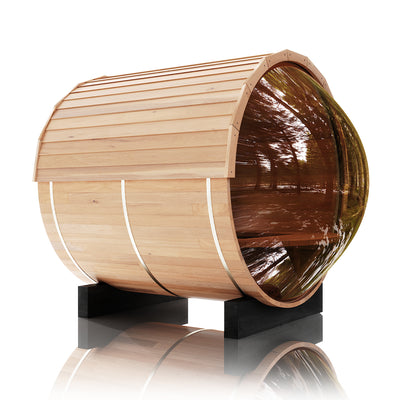
Not every outdoor sauna uses the same wall system. Some barrel saunas rely mainly on thick solid wood rather than conventional insulated framing. Cabin saunas may combine framing, insulation, foil vapor control, interior paneling, and exterior cladding. Both approaches can work when engineered and assembled correctly, but their heat-up behavior may differ.
Glass Area
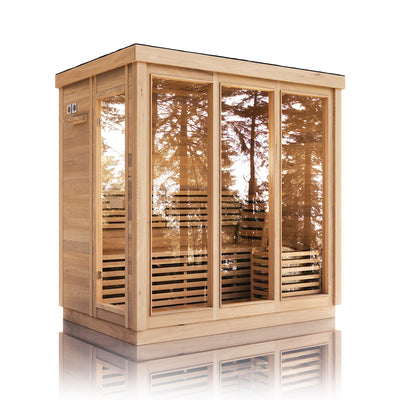
Glass creates openness and views, but it generally loses heat faster than an insulated wall. Manufacturers often account for glass and other uninsulated surfaces by adding an equivalent volume when sizing the heater. A panoramic window can therefore affect both the required heater rating and the outdoor sauna electricity cost.
This does not mean glass is a poor choice. It means the aesthetic decision has an energy consequence. Homeowners should compare models using manufacturer sizing guidance and realistic winter expectations rather than assuming two saunas with the same floor dimensions will consume the same energy.
Doors, Seals, And Air Leakage
A door that does not close squarely or a seal damaged by weather can allow unnecessary air exchange. Repeatedly opening the door during a session also releases hot air and introduces cold replacement air. Good habits, accurate assembly, and routine inspection support efficiency without compromising ventilation.
Ventilation
Sauna ventilation is essential for comfort, heater operation, and drying. It should not be eliminated in pursuit of lower bills. The correct inlet and outlet arrangement depends on heater type and manufacturer guidance. Excessive or incorrectly placed airflow can increase heating demand, while inadequate airflow can make the sauna uncomfortable and create moisture problems.
Usage Frequency: Weekly, Monthly, And Annual Cost
Once you have an estimated cost per session, multiply it by expected frequency. A sauna that costs $1.50 per session adds about $6 per month when used weekly, roughly $13 per month when used twice weekly, and about $20 per month when used three times weekly. Daily use would be approximately $45 per month using a 30-day month.
|
Cost per session
|
1x weekly (52/year)
|
2x weekly (104/year)
|
3x weekly (156/year)
|
Daily (365/year)
|
| $1.00 |
$52 |
$104 |
$156 |
$365 |
| $1.50 |
$78 |
$156 |
$234 |
$548 |
| $2.00 |
$104 |
$208 |
$312 |
$730 |
| $3.00 |
$156 |
$312 |
$468 |
$1,095 |
Annual figures make small differences visible. Reducing a session by 25 cents saves only a dollar per month for weekly use, but about $91 per year for daily use. Efficiency investments should be evaluated against actual frequency. A costly upgrade that saves a few cents per occasional session may never repay itself, while good insulation and accurate controls can matter much more for frequent users in cold climates.
Realistic Household Scenarios
Scenario 1: Compact Sauna Used Once A Week
A homeowner has a 4.5kW heater, a mild climate, and an average 75-minute operating window. The full-power ceiling is 5.625 kWh. At 18.44 cents per kWh, the maximum planning cost is about $1.04 per session. Weekly use is approximately $54 per year before considering cycling, which may reduce actual use.
Scenario 2: Six-Kilowatt Sauna Used Three Times A Week
The sauna warms for 45 minutes at full power and remains available for another 45 minutes at an assumed 50% duty cycle. Estimated energy is 4.5 kWh during warm-up plus 2.25 kWh during bathing, or 6.75 kWh. At 18.44 cents per kWh, the estimated session costs $1.24. Three sessions per week equal about $16 per month and $194 per year.
Scenario 3: Nine-Kilowatt Sauna In A Cold Climate
A larger glass-front sauna warms for one hour at full power and is used for another hour at an assumed 65% duty cycle. Estimated energy is 9 kWh plus 5.85 kWh, or 14.85 kWh. At 18.44 cents per kWh, the session costs about $2.74. Twice-weekly use is approximately $23.75 per month and $285 per year.
Scenario 4: High Utility Rate And Daily Use
A 6kW heater operates for 90 minutes under the conservative full-power assumption in an area charging 30 cents per kWh. Each session costs $2.70. Daily use would reach about $81 in a 30-day month and $986 per year. Thermostat cycling may lower the result, but the example demonstrates how rate and frequency can outweigh heater size.
Accessories And Standby Power
The heater dominates sauna electricity use. LED lighting, digital controls, and small ventilation fans usually draw far less power, although their exact consumption depends on the equipment. A 20-watt light operated for two hours uses only 0.04 kWh, costing less than one cent at 18.44 cents per kWh. By comparison, a 6kW heater running for the same two hours at full output uses 12 kWh.
Smart controllers can consume a small amount of standby power because displays and network components remain active. Across a full year, standby use can become measurable, but it is usually minor next to frequent heating sessions. Larger accessories such as heated floors, pumps for a cold plunge, exterior heaters, or electric water heating should be calculated separately rather than attributed to the sauna heater.
Does A Bigger Heater Always Cost More To Run?
At any instant when both heaters are fully energized, the larger heater draws more power. A 9kW unit draws 50% more than a 6kW unit. Over an entire session, however, total consumption depends on how long each heater operates and how effectively it cycles. A correctly sized 9kW heater in a room that needs 9kW should not be replaced with an undersized 6kW model simply to reduce the nameplate number.
The smaller unit may require a much longer warm-up, operate continuously, fail to recover after water is added to the stones, or never reach the desired temperature in winter. Comfort and energy efficiency both depend on matching the heater to the room volume, glass area, construction, and climate.
Oversizing is not automatically efficient either. The heater and controls must remain within the manufacturer-approved room range. The best operating cost comes from proper sizing, not choosing the smallest or largest unit in isolation.
Traditional Electric Sauna vs Infrared Electricity Use
Traditional electric saunas heat the room air, interior surfaces, and stones to high temperatures. Infrared systems heat the body more directly and typically operate at lower air temperatures. Because the technologies create different experiences, comparing only kWh can be misleading.
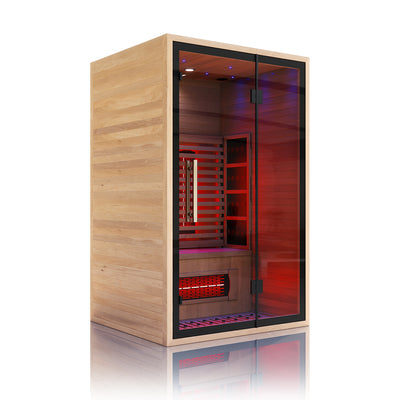
An infrared cabin may use a lower electrical rating and require less warm-up time, but it does not provide the same high-temperature environment or steam from sauna stones. A homeowner choosing between them should first decide which bathing experience is desired, then compare the energy cost of achieving that experience.
Electric vs Wood-Burning Operating Cost
A wood-burning sauna does not use a large electric heating circuit, but its heat is not free. Firewood has a purchase or collection cost, requires dry storage, and demands loading, ash removal, chimney maintenance, and more hands-on operation. Local fire restrictions and emissions rules may also affect use.
Electric heating is easier to calculate because the heater rating and utility price are known. Wood cost depends on species, moisture, local supply, stove efficiency, and how much fuel is burned. The better choice is usually based on site, desired ritual, convenience, and fuel availability rather than a universal claim that one system is cheaper.
How To Reduce Outdoor Sauna Electricity Cost
-
Use the correct heater size: follow the manufacturer room-volume method, including adjustments for glass and uninsulated surfaces.
-
Preheat accurately: learn the real warm-up time in different seasons instead of starting much earlier than necessary.
-
Group users together: one longer family session generally avoids repeated warm-up cycles.
-
Maintain doors and seals: correct misalignment and weather-related gaps that create unintended heat loss.
-
Protect construction quality: repair roof leaks, wet insulation, or damaged exterior details before they affect performance.
-
Follow ventilation guidance: use the intended airflow arrangement rather than wasting heat through improvised openings.
-
Choose off-peak hours: when a time-of-use plan makes the same kWh less expensive later in the day.
-
Turn the sauna off when finished: avoid leaving it hot for an uncertain second session.
-
Measure before upgrading: use utility data or safe submetering to identify the real source of consumption.
Efficiency should never come from bypassing safety controls, covering the heater, reducing clearances, blocking required ventilation, modifying sensors, or performing unauthorized electrical work. Manufacturer instructions and local code are the controlling requirements.
How To Measure Actual Sauna Electricity Use
Calculations are useful before purchase, but measurement provides the best answer after installation. Because traditional sauna heaters are often hardwired high-load appliances, common plug-in energy meters are not appropriate. Ask a licensed electrician about a compatible circuit monitor, panel-based energy monitor, or submeter.
Utility interval data can provide a simpler comparison. Record the time the sauna starts and stops, then review the household load in the utility portal. Compare it with a similar day when major appliances, vehicle charging, and heating loads were otherwise consistent. The difference will not be laboratory-perfect, but repeated observations can reveal a stable pattern.
-
Record outdoor temperature: warm-up energy varies with weather.
-
Record starting and set temperatures: a hotter target or colder cabin changes demand.
-
Record warm-up and bathing times: separate the two stages when reviewing consumption.
-
Record users and door openings: behavior can change cycling.
-
Repeat the test: one session may be distorted by other household loads.
-
Compare seasons: winter and mild-weather averages are more useful than one annual assumption.
Common Electricity-Cost Estimating Mistakes
-
Confusing kW with kWh: kilowatts describe power; kilowatt-hours describe energy over time.
-
Counting bathing time only: warm-up is often the largest portion of the session.
-
Assuming continuous full power is exact: it is a conservative ceiling, not a meter reading after thermostat cycling.
-
Using a national rate instead of the utility bill: regional prices and rate structures vary widely.
-
Ignoring glass and insulation: two saunas with the same floor area can have different heat loss.
-
Choosing an undersized heater: long run times and poor performance can erase expected savings.
-
Forgetting frequency: a modest session cost can become meaningful with daily use.
-
Attributing the whole bill increase to the sauna: weather, HVAC, vehicle charging, and billing days may change at the same time.
-
Including fixed charges as variable cost: monthly customer fees often exist whether or not the sauna operates.
Frequently Asked Questions
How Much Does It Cost To Run An Outdoor Sauna For One Hour?
At the May 2026 U.S. residential average of 18.44 cents per kWh, full-power operation costs about $0.83 for a 4.5kW heater, $1.11 for a 6kW heater, $1.48 for an 8kW heater, and $1.66 for a 9kW heater. Actual use may be lower after the thermostat begins cycling.
How Much Electricity Does A 6kW Sauna Heater Use?
A 6kW heater uses up to 6 kWh during one continuous full-power hour. A 90-minute full-power window uses up to 9 kWh. If the heater cycles after warm-up, measured consumption may be lower.
How Much Electricity Does A 9kW Sauna Heater Use?
A 9kW heater uses up to 9 kWh per continuous full-power hour. At 18.44 cents per kWh, that is about $1.66. A 90-minute maximum-load estimate is 13.5 kWh and approximately $2.49.
Does An Outdoor Sauna Increase The Electric Bill A Lot?
For occasional use, the increase is often modest. A sauna costing $1.50 per session adds about $6 per month when used weekly and about $13 per month when used twice weekly. High electricity rates, daily use, long sessions, and cold-weather heat loss can raise the total.
Is It Cheaper To Leave A Sauna Hot?
For normal residential use, reheating for planned sessions is generally more sensible than maintaining bathing temperature for long unused periods. Keeping the sauna hot continuously replaces heat losses hour after hour. Follow the control instructions and turn the system off when the session is complete.
Do Sauna Heaters Run At Full Power The Entire Time?
They often run strongly during warm-up. After reaching the setpoint, the thermostat normally cycles the elements to maintain temperature. The actual duty cycle depends on weather, insulation, glass, ventilation, setpoint, door use, and heater-room matching.
Are Outdoor Saunas More Expensive To Run In Winter?
Usually. The room begins colder and loses heat faster because the temperature difference between indoors and outdoors is greater. Warm-up may take longer, and the heater may cycle more frequently during the session.
Can Solar Panels Power An Outdoor Sauna?
Grid-connected solar can offset household electricity consumption over time, but a sauna heater still creates a large instantaneous load. Whether a solar and battery system can supply that load depends on inverter capacity, battery output, service design, and utility rules. An electrician or solar designer should evaluate the specific heater.
How Can I Find My Local Electricity Rate?
Check the latest utility bill or online account. Identify the variable energy and delivery charges that apply to additional kWh, including time-of-use or tiered pricing. If the bill is unclear, ask the utility for the marginal residential rate applicable to your plan.
Key Takeaways
-
Start with the formula. Heater kW x operating hours x local $/kWh provides the conservative baseline.
-
Use your own utility rate. The May 2026 U.S. residential average was 18.44 cents per kWh, but local prices can differ dramatically.
-
Count warm-up time. The session begins electrically before anyone sits on the bench.
-
Expect thermostat cycling. Full-power math is a ceiling; measured use may fall after the sauna reaches temperature.
-
Account for climate and construction. Cold weather, glass, air leakage, and insulation influence warm-up and cycling.
-
Size the heater correctly. An undersized heater is not a reliable energy-saving strategy.
-
Multiply by frequency. Monthly and annual use determine whether small per-session differences matter.
-
Measure when accuracy matters. Utility interval data or electrician-approved monitoring beats assumptions.
Final Verdict: Most Outdoor Sauna Sessions Cost Less Than Homeowners Expect
For many residential outdoor saunas, electricity is a manageable operating expense rather than a financial surprise. At the May 2026 national residential average, one full-power hour costs approximately $1.11 with a 6kW heater and $1.66 with a 9kW heater. A complete session may cost roughly one to several dollars depending on warm-up, bathing time, thermostat cycling, weather, and local rates.
The outdoor sauna electricity cost becomes most significant when several factors combine: a high utility rate, daily use, long operating windows, large glass areas, cold exposure, or a heater that is poorly matched to the room. Homeowners can control many of these variables through accurate preheating, good maintenance, grouped sessions, off-peak scheduling, and sound construction.
The most honest estimate is not a single national number. It is a small calculation based on the exact heater, the full operating window, and the incremental rate on the homeowner's bill. Use full-power math when planning conservatively, refine the estimate with a warm-up and duty-cycle model, and confirm it with actual energy data once the sauna is operating.
A well-designed outdoor sauna should encourage regular use without making every session feel financially consequential. When the heater is correctly sized and the cabin retains heat as intended, the cost of a session is often comparable to other ordinary household comforts while delivering a much more memorable experience.



 OUR BEST SELLERS